
Melanie Love
Drawing On Experience: An El Duende Heuristic Inquiry into Late-Diagnosed AuDHD
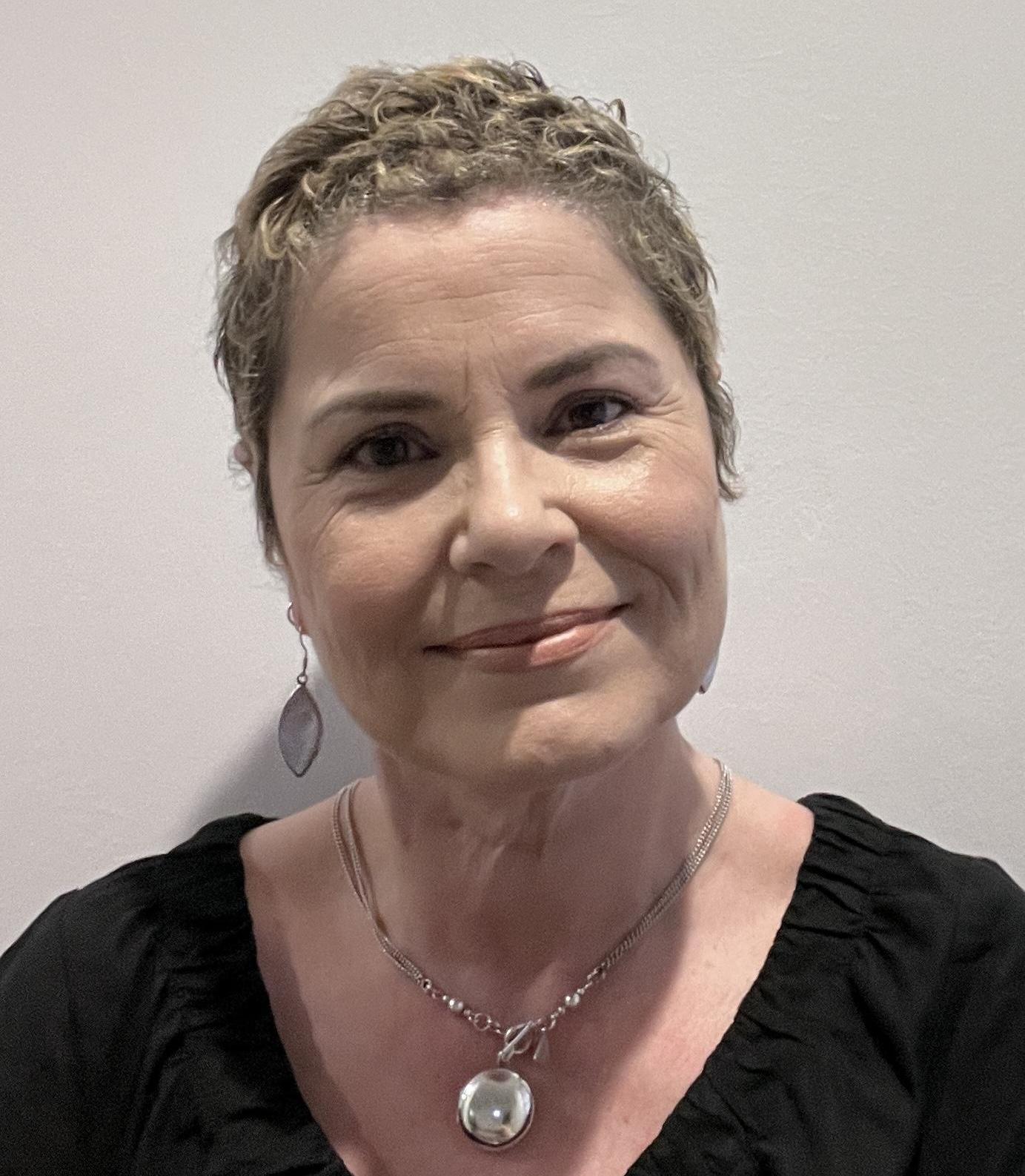 Melanie is mental health nurse and emerging art therapist. Her academic journey reflects a lifelong curiosity and deep engagement with diverse subjects in humanities, sciences and the creative arts. She draws on over three decades of extensive mental health experience gained across several countries, and relocated to Australia to study the Master of Mental Health (Art Therapy) programme.
Having once commenced formal arts training but ultimately pivoting to pursue her nursing career, Melanie has maintained a lifelong personal art practice. She experienced a profound shift in her creative engagement whilst processing a succession of deeply personal events in which art-making provided a critical space for psychological containment, emotional processing, and internal resolution. Melanie’s recognition of the non-verbal therapeutic power of art during this time fuelled her desire to merge her professional mental health expertise with her private art practice, and afforded the motivation for her transition into art therapy.
Melanie’s creative style is eclectic. Driven by an interest in nature, environmental sustainability, and eco-conscious practice, she prioritises the use of natural, found, thrifted, and re-cycled materials wherever possible. She is not governed by strategic planning when creating art, and views the gathering of materials, selection of colours, and choice of textures, as integral to the creative dialogue and flow of the art-making process.
Underpinned by evidence that neurodiversity has been systematically and systemically missed in women for generations, coupled with a significant gap in literature examining the intersection of both conditions, and prompted by her own late diagnosis of AuDHD, received during the first year of her Master’s studies, Melanie’s research utilises a heuristic inquiry combined with the El Duende process painting method. It examines how the academic journey of becoming an art therapist assists in synthesising a new, late, neurodivergent identity. El Duende’s continuous layering process - the building and re-working of a single canvas, provides a vital tool for self-synthesis, and a mirror for unpacking complex lived experiences.
Whilst Melanie’s exhibition documents her research process, the artworks are intrinsically intertwined with her research topic and are inherently shaped by her specific cognitive and sensory processing. Each piece is a record of the unique nervous system and executive workflow that executed the research, and reflects the eclectic style of her art- making.
Although her experience as a mental health nurse spans a wide clinical demographic, ultimately, Melanie aims to facilitate the transformative qualities of art therapy practice for a broader spectrum of individuals.
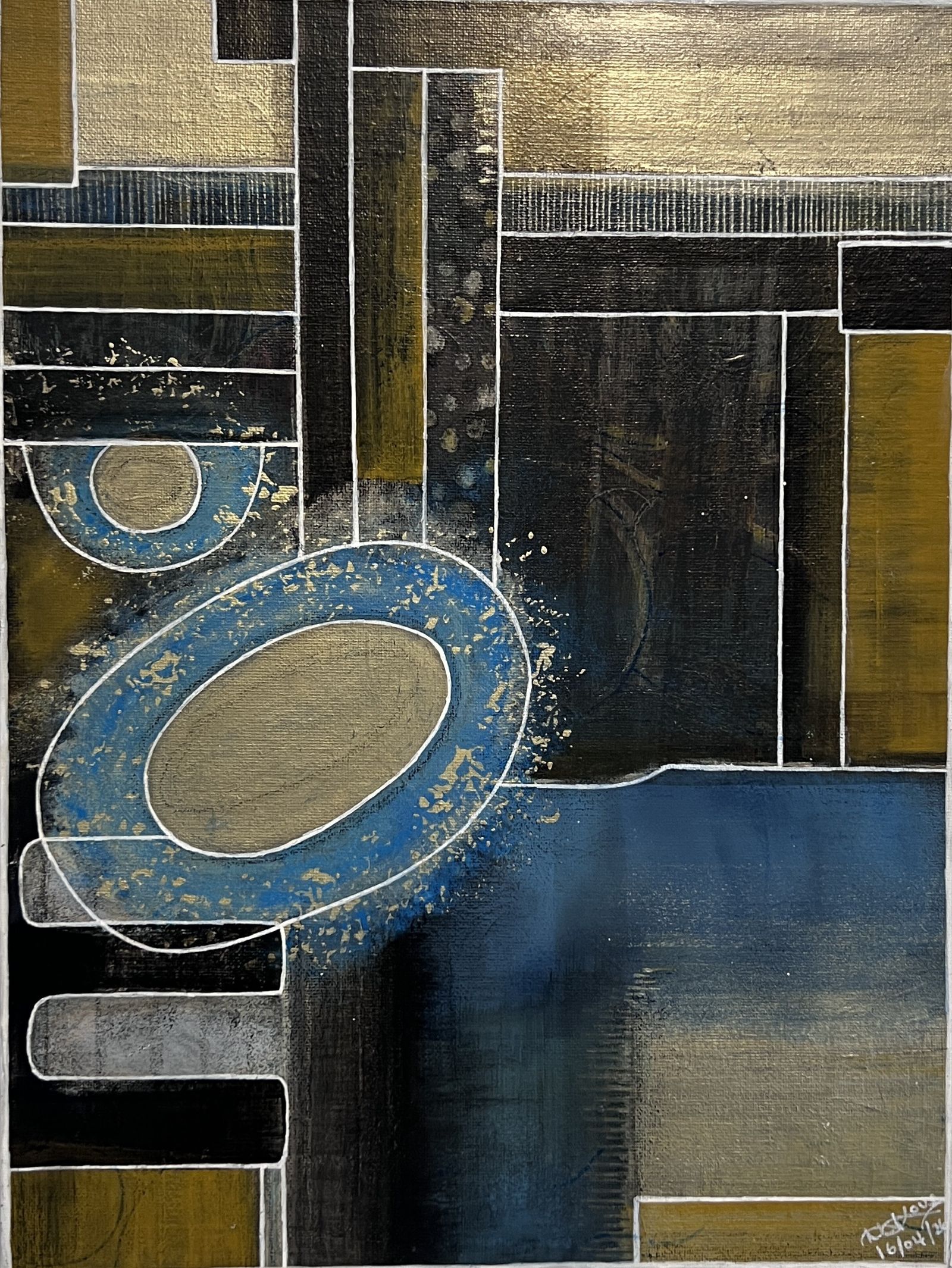
Acrylic paint, Posca pen, and acrylic matte lacquer on a re-used canvas panel
30cm x 40cm
Lines and colour blocks. Mental and conceptual boundaries implemented to contain the stream of 'white noise' interrupting academic flow. The essential structure, organisation, and clarity needed for the research journey.
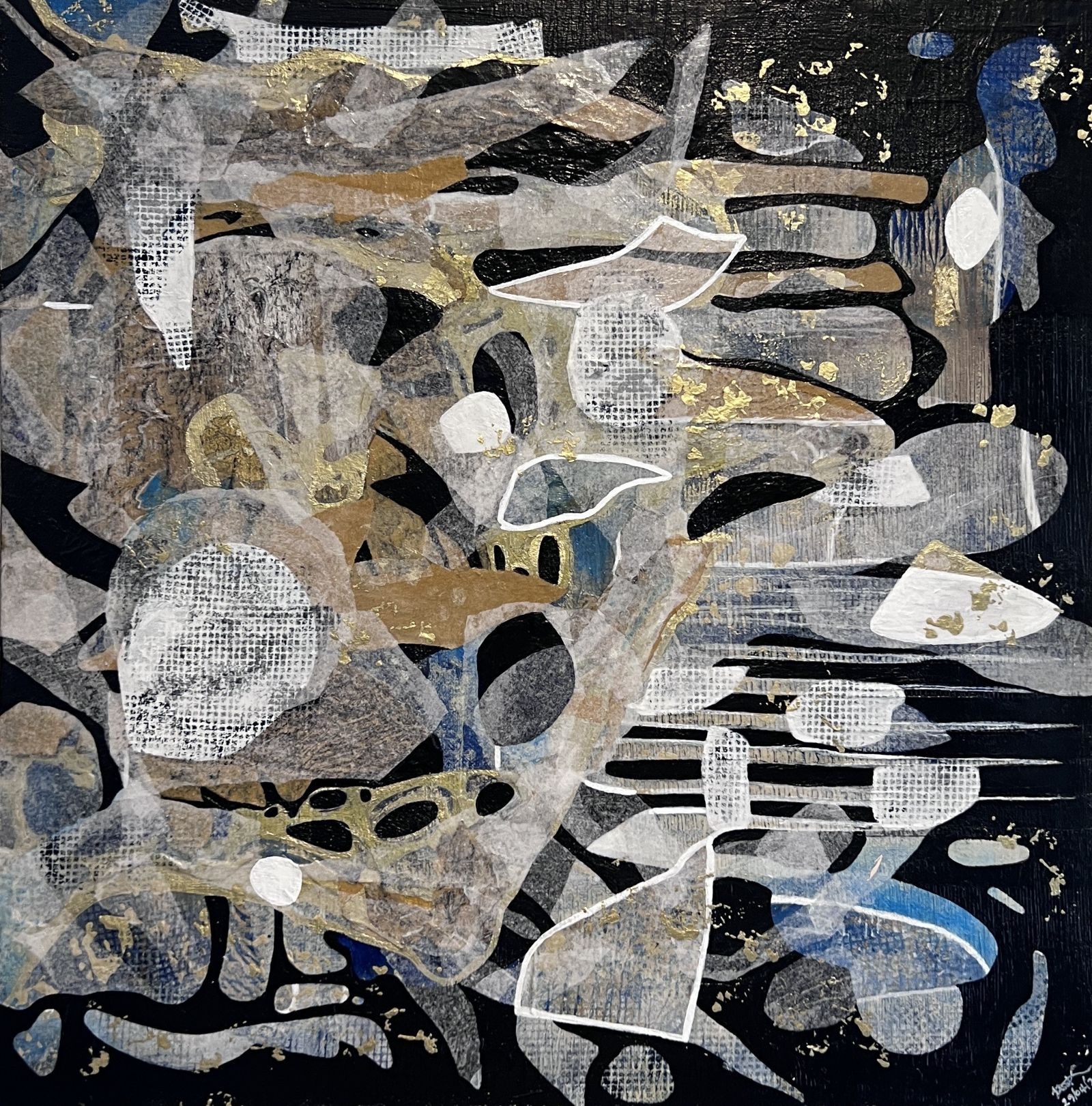
Acrylic paint, craft paper, tissue paper, moulding paste, Posca pen, gel matte medium, gold leaf, fibreglass mesh and acrylic matte lacquer on a re-used canvas panel.
46cm x 46cm
Non-linear, wild streams of thought, experiences, academia and creativity that exist and converge in interconnected chaos. A necessity. A sanctuary to retreat to when stuck. Imagination flows. With Compartmentalisation, it is symbiosis.

Paper mâché, acrylic paint, acrylic pen, and acrylic matte lacquer on an up-cycled corrugated plastic panel.
90cm x 60cm
The dark, often isolating world of research. The words of Charles C. Finn, golden, repetitive, depicting the high energy of masking with the distinctive, yet performative decorative masks, essential to navigate the exhaustive research process. (Inspired by Charles C. Finn’s (1966) poem ‘Please Hear What I’m Not Saying’)
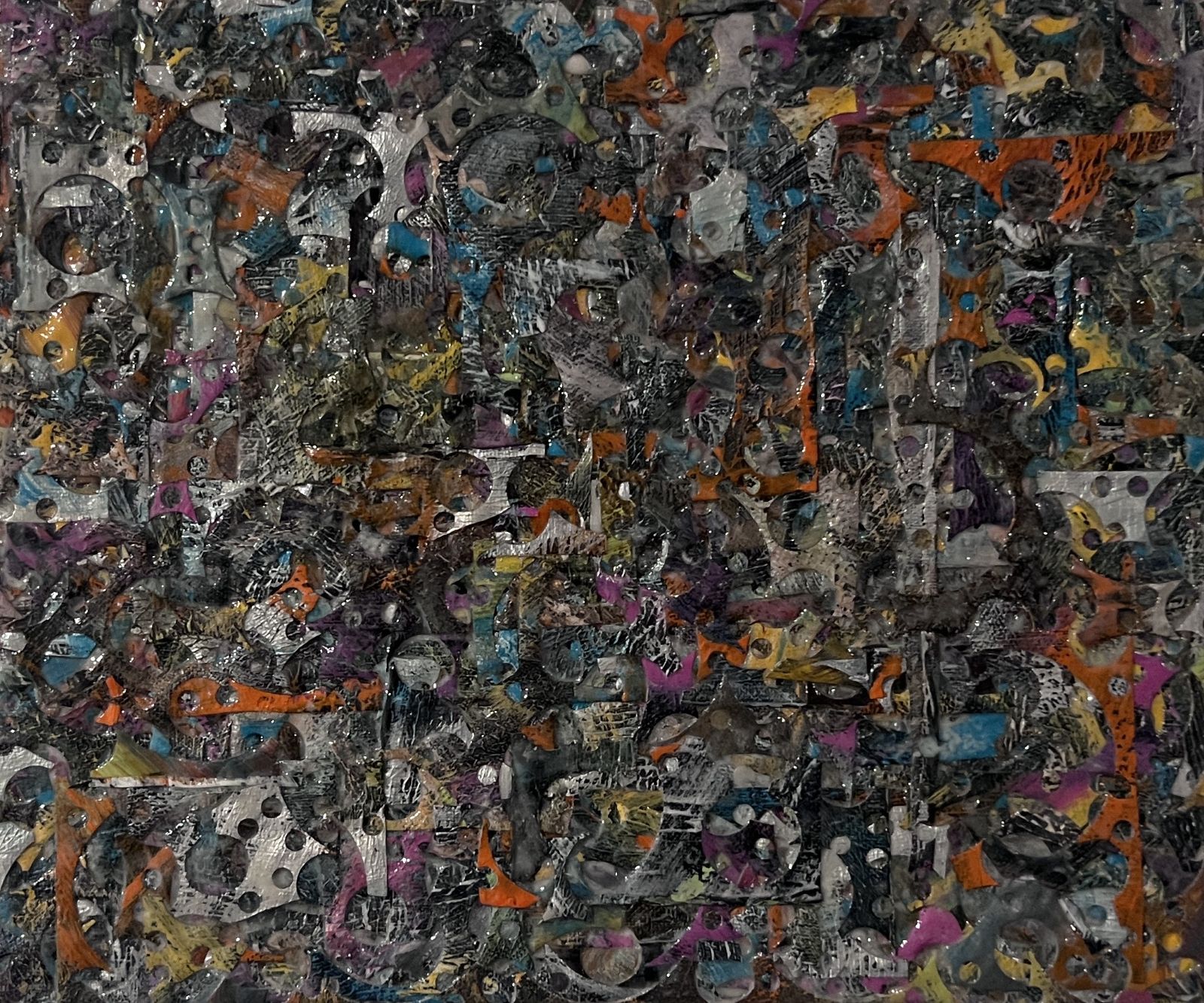
Up-cycled scrap canvas, acrylic paint, and acrylic gloss lacquer on a re-used canvas panel.
25.4cm x 30.5 cm
A brain-like labyrinth harbouring a singular, inconspicuous point of clarity. Not a performative trick, but an involuntary, hypnotic pull into total immersion, into flow state.
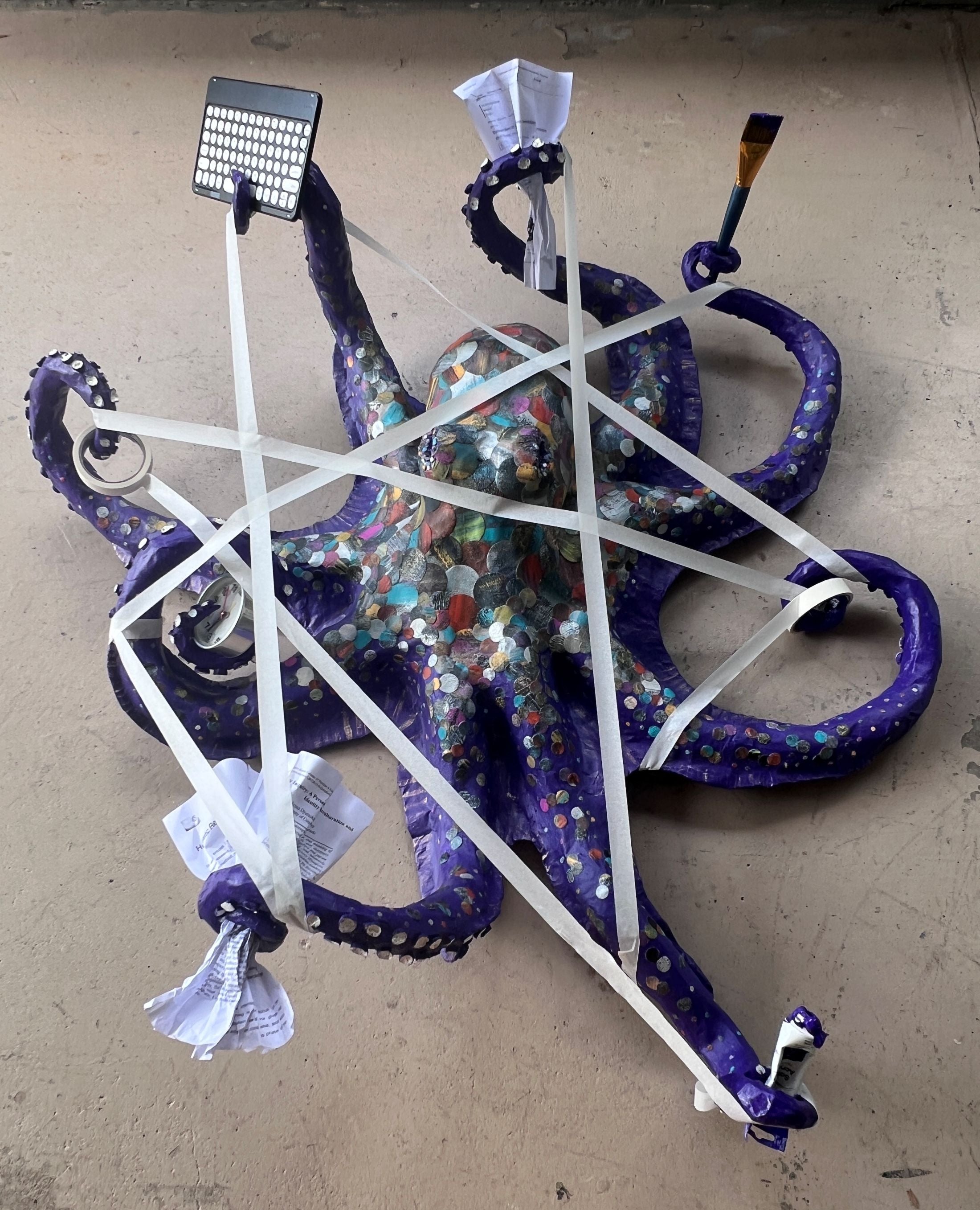
Household plastic waste, tinfoil, masking tape, plaster of Paris strips, paper mâché, acrylic paint, up-cycled art canvas, acrylic gloss, thrifted clock, thrifted keyboard, photocopied research literature, paint tube, and paintbrush.
1m 8cm x 1m 23cm.
Innumerous tasks, too few hands. Often sinuously dexterous but, at times, clumsily inept, caught up in the sticky, endless tape of academia. Stretched to the limits, the purple paint and paintbrush signify autonomy, resilience and the ability to self-heal.
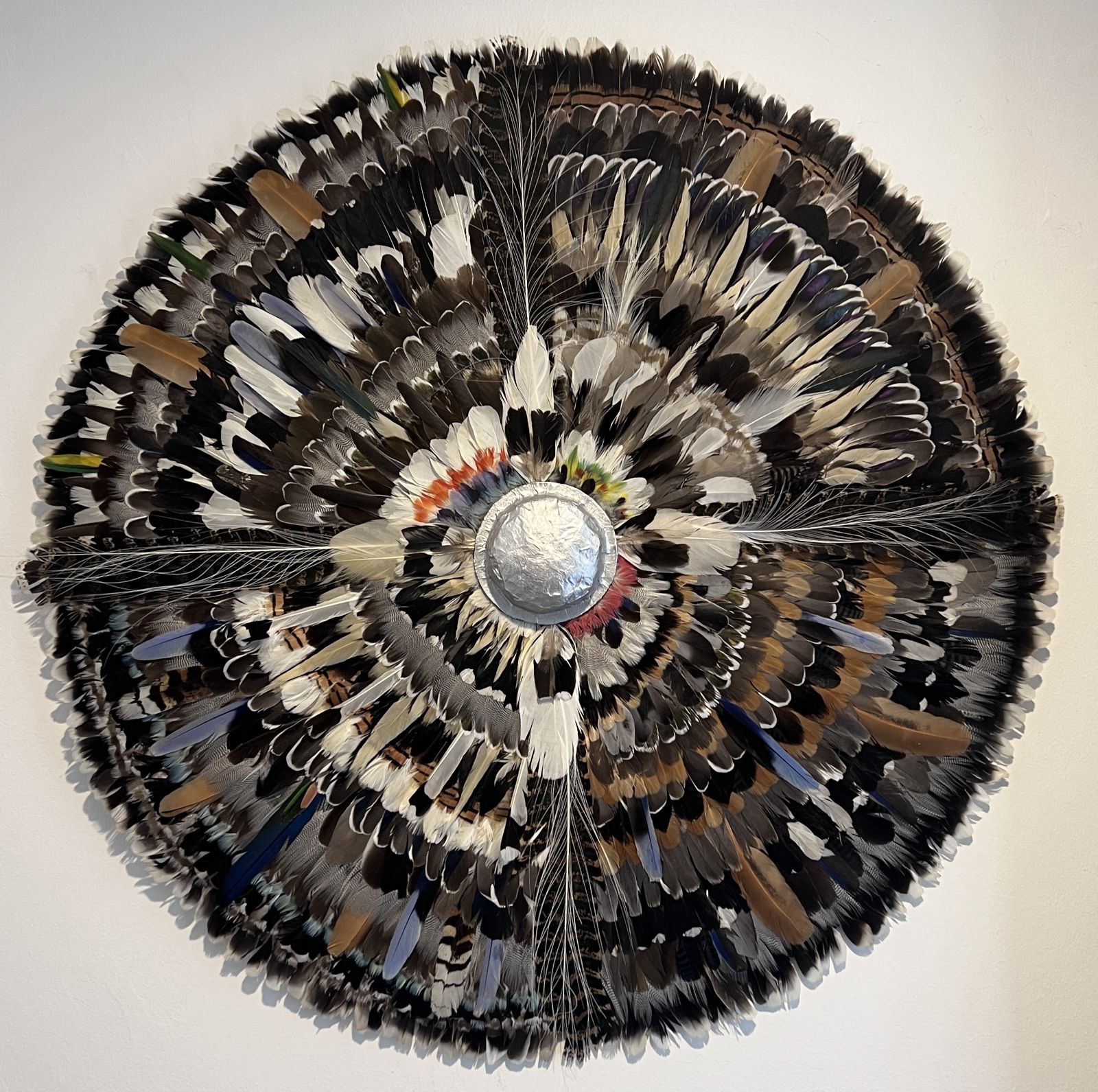
Found feathers, paper mâché, gesso, and acrylic paint on a reused canvas and up-cycled corrugated plastic panel.
73cm x 73cm
The daily quest. Found feathers. A circular shield, marking time. The plumage encouraging, protective. At its heart, the battered silver boss absorbs life’s vicissitudes.
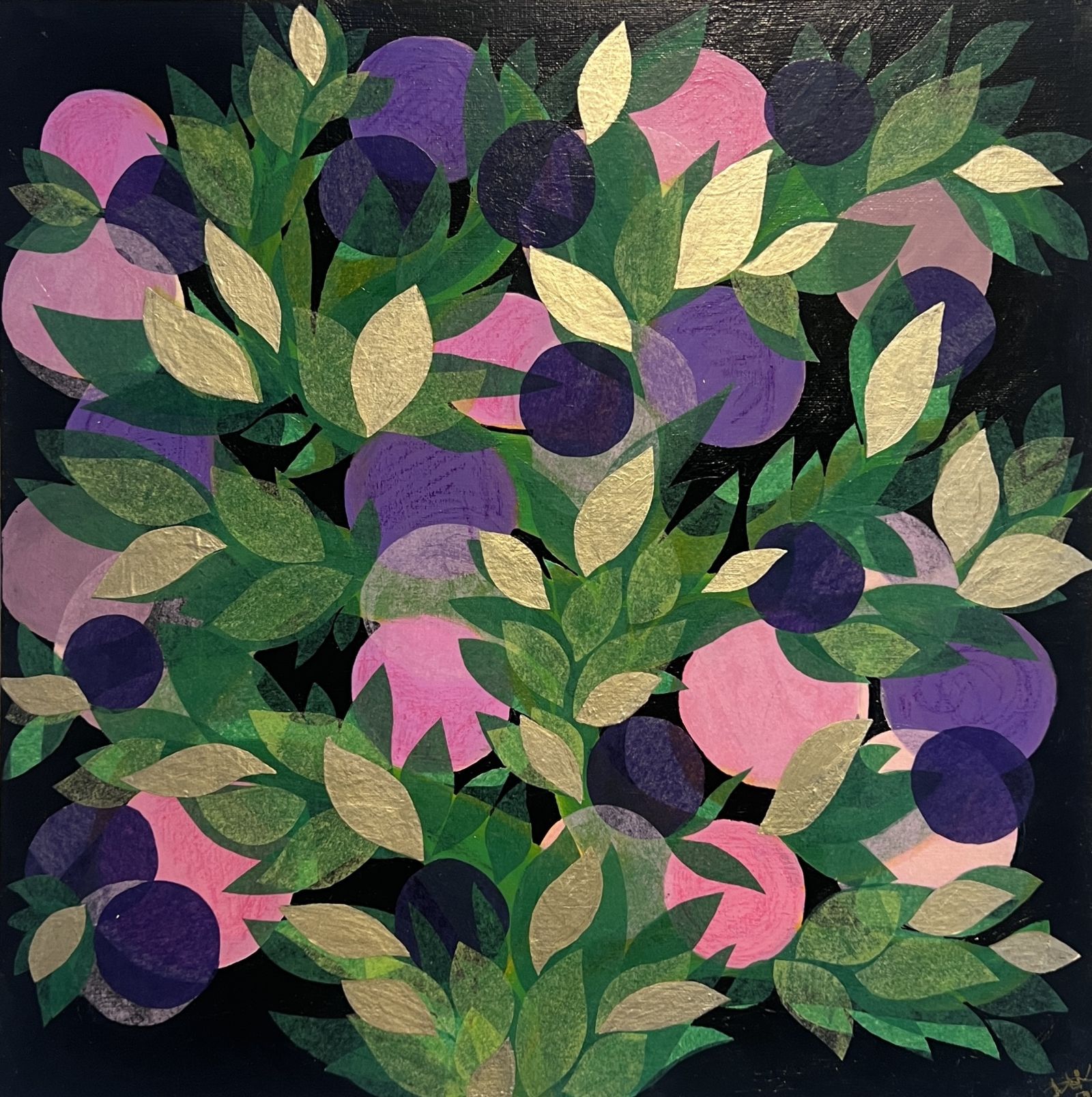
Collaged tissue paper, acrylic paint, wax crayon, and acrylic matte lacquer on a re-used canvas panel.
46cm x 46cm
Abundance boasts the bounty of research’s Autumn, the hard-earned fruits from the long, slow season of the research process (Inspired by John Keats’ (1820) poem, ‘To Autumn’).
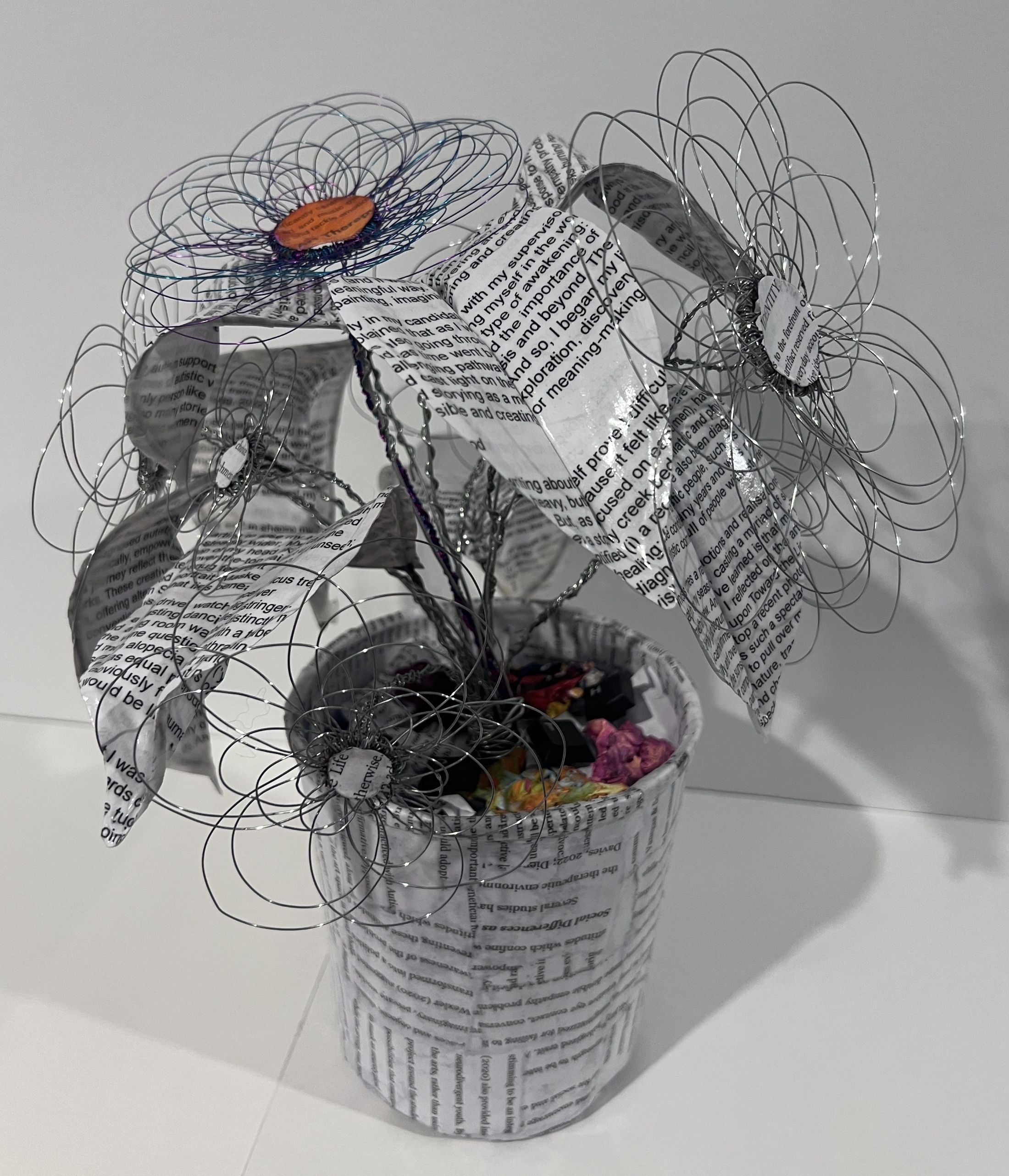
Waste research documents, thrifted wire, dried acrylic paint, and computer keys.
35cm x 25cm
Within its nurturing pot of words and colour, growth awakens, and the long-awaited bloom flourishes, its greenhouse redundant.